If you’ve been diagnosed with obstructive sleep apnea (OSA), you’re likely weighing your treatment options. For decades, Continuous Positive Airway Pressure—commonly known as CPAP—has been the default recommendation. But it’s far from the only option, and for many patients, it’s not the best one. Oral appliance therapy (OAT) has emerged as a clinically proven, patient-preferred alternative that’s transforming how millions of people manage their sleep apnea.
Understanding the differences between these two treatments—how they work, their effectiveness, their practical realities, and what the research says about patient adherence—is essential to making an informed decision. In this guide, we’ll give you a clear, evidence-based comparison so you can work with your healthcare provider to choose the path that actually leads to better sleep.
Understanding Your Options
Both CPAP and oral appliance therapy aim to keep your airway open during sleep, preventing the breathing pauses that define obstructive sleep apnea. However, they accomplish this through fundamentally different mechanisms, and those differences have a major impact on your nightly experience, long-term compliance, and ultimately, your health outcomes.
The best treatment for sleep apnea is the one you actually use. That may sound obvious, but it’s the single most important insight in sleep medicine today. A treatment that works perfectly in theory but sits unused in a drawer does nothing for your health. This is where the conversation between CPAP and oral appliance therapy becomes especially important.
How CPAP Works—and Why Many Patients Struggle
CPAP therapy uses a machine that delivers a continuous stream of pressurized air through a mask worn over the nose, mouth, or both. This air pressure acts as a pneumatic splint, holding the airway open and preventing the soft tissue collapse that causes obstructive apnea events. When used consistently, CPAP is highly effective at eliminating apneas and restoring normal oxygen levels during sleep.
The challenge is that “used consistently” part. CPAP compliance rates are among the most widely studied—and most sobering—statistics in sleep medicine. Research consistently shows that approximately 50 percent of patients prescribed CPAP stop using it within the first year. Some studies place non-adherence even higher, with up to 83 percent of patients failing to meet the minimum usage threshold of four hours per night on 70 percent of nights.
The reasons are practical and deeply personal. Many patients find the mask uncomfortable, claustrophobic, or difficult to keep sealed—air leaks are a constant frustration that can dry out the eyes and reduce treatment effectiveness. The machine generates noise that can disturb both the patient and their bed partner. The hose can become tangled during sleep, restricting movement and waking the user. Some patients experience nasal congestion, dry mouth, skin irritation, or aerophagia (swallowing air, which causes bloating and gas).
Travel with CPAP presents its own set of challenges. The machine requires electricity, takes up luggage space, and creates complications going through airport security. For patients who camp, hike, or travel to areas without reliable power, CPAP may simply not be feasible. The psychological burden is real as well: many patients report feeling self-conscious about wearing the mask in front of a partner, and some develop anxiety around bedtime because of the device.
How Oral Appliance Therapy Works
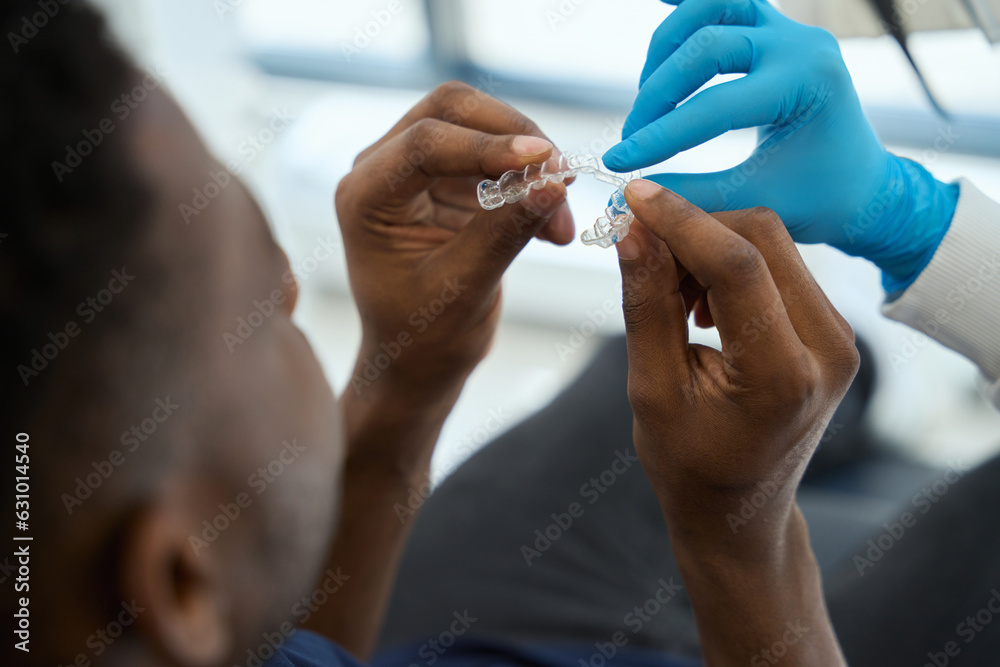
Oral appliance therapy takes a completely different approach. A custom-fitted device—similar in size and feel to an orthodontic retainer or a thin sports mouthguard—is worn in the mouth during sleep. The appliance gently repositions the lower jaw slightly forward, which tightens the soft tissues and muscles of the upper airway and prevents the collapse that causes obstruction. Some devices also hold the tongue forward to further open the breathing passage.
These devices are custom-fabricated by a dentist trained in dental sleep medicine, using digital or physical impressions of your teeth. The fit is precise, the adjustment is gradual, and the entire process is managed by a clinician who monitors your comfort and treatment effectiveness through follow-up visits and, in many cases, home sleep testing to verify results.
The advantages of oral appliance therapy are significant and well-documented. Patients consistently report higher satisfaction and comfort compared to CPAP. The device is completely silent—no humming motor, no rushing air, no mask leaks. It fits in the palm of your hand, making it effortless to travel with. It requires no electricity, no water reservoir, no hoses, and no nightly setup ritual. You simply place it in your mouth, close your eyes, and sleep.
Perhaps most importantly, oral appliance therapy boasts dramatically higher compliance rates than CPAP. Studies published in the Journal of Clinical Sleep Medicine show that patients use their oral appliances an average of 6.6 hours per night—far exceeding the typical CPAP usage of around 4 hours. And because patients actually use the device, the real-world effectiveness of oral appliance therapy often matches or exceeds CPAP. A treatment that’s 80 percent effective and used every night delivers better outcomes than one that’s 95 percent effective but abandoned in a closet.
Which Treatment Is Right for You?
The American Academy of Sleep Medicine (AASM) recommends oral appliance therapy as a first-line treatment for mild to moderate obstructive sleep apnea, and as an alternative for patients with severe OSA who cannot tolerate CPAP. In practice, this means the vast majority of sleep apnea patients are candidates for oral appliance therapy.
Oral appliance therapy may be especially well-suited for you if: you’ve tried CPAP and couldn’t tolerate it; you travel frequently for work or leisure; you prefer a simple, low-maintenance treatment; you sleep on your side or stomach and find a mask disruptive; you share a bed with a partner who is disturbed by CPAP noise; or you want a discreet treatment that doesn’t change your bedtime routine.
CPAP may still be the right choice for patients with severe obstructive sleep apnea who tolerate the device well, patients with central or complex sleep apnea (which oral appliances do not treat), or patients who require very high airway pressures to eliminate apnea events. In some cases, combination therapy—using an oral appliance together with a lower-pressure CPAP setting—provides the best results.
Making the Switch
If you’re currently using CPAP and struggling with compliance—or if you’ve abandoned your CPAP altogether—you’re not alone, and you’re not without options. Switching to oral appliance therapy is straightforward. Your dentist will work with your sleep physician to review your diagnosis, take impressions, fabricate your custom device, and calibrate it over several visits to optimize both comfort and therapeutic effectiveness.
Many patients report transformative results within the first few weeks: deeper sleep, more energy, fewer headaches, better mood, and a partner who finally gets a quiet night’s rest too. Long-term studies show sustained benefits for cardiovascular health, metabolic function, and cognitive performance.
The bottom line is this: the best treatment for sleep apnea is the one that works and that you’ll actually use, night after night. For a growing number of patients, that treatment is oral appliance therapy. If you’re ready to explore whether an oral appliance is right for you, Sleep Architects can connect you with a qualified dental sleep medicine provider in your area. Reach out to us at reachus@sleeparchitx.com to take the first step toward better sleep.